Compact protection with clear process visibility.
Formed polycarbonate can follow the shape of a mechanism, reduce unnecessary enclosure volume and preserve visibility around belts, pulleys, couplings, shafts, tooling and product-transfer points. A well-detailed guard also considers how it will be removed, cleaned, inspected and replaced.
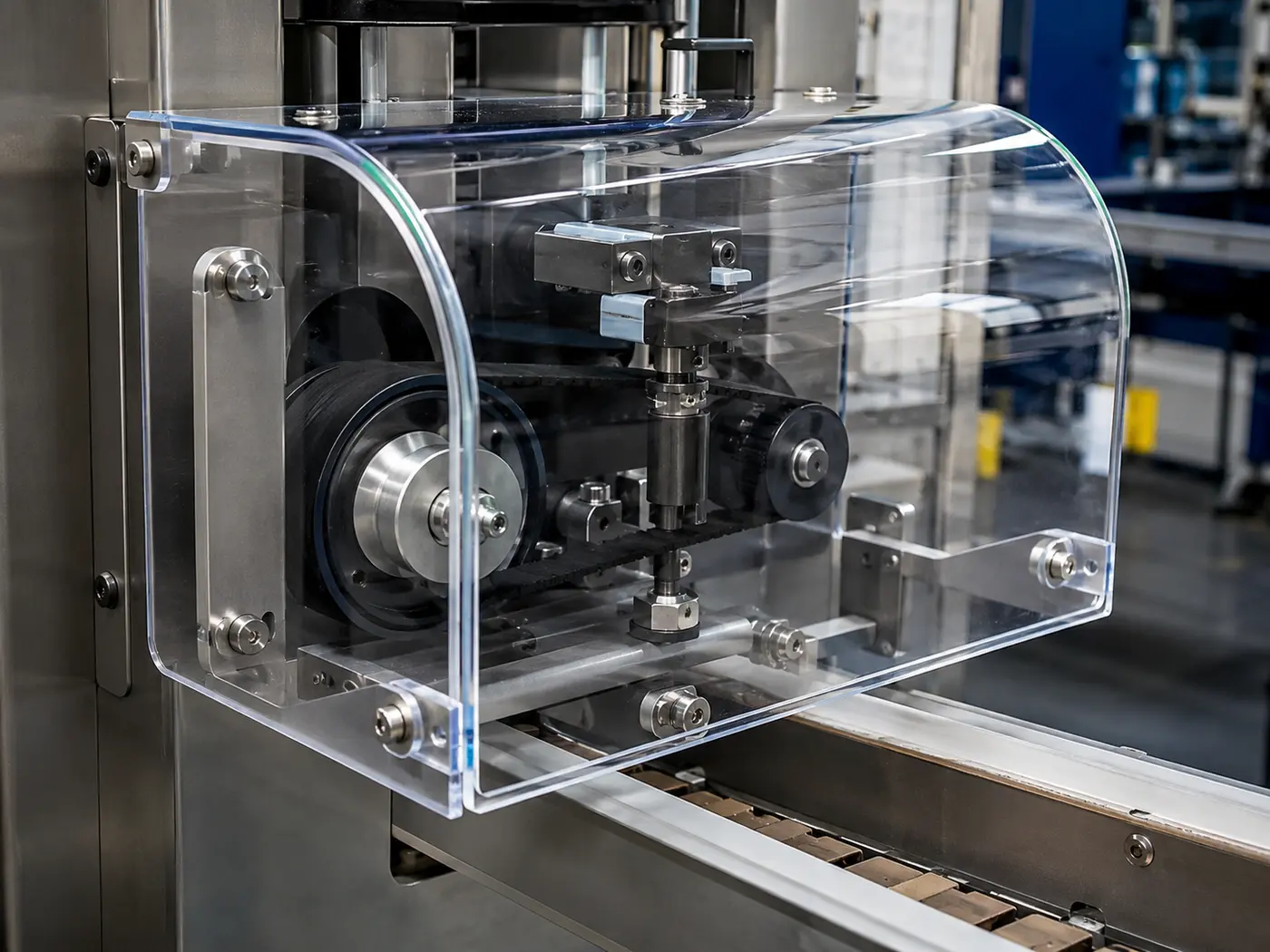
Common design forms.
Folded covers
Two or more faces formed from one clear sheet to reduce joints and improve visibility.
Radiused guards
Smooth curved transitions around rotating equipment, drive systems and machine corners.
Hybrid assemblies
Formed polycarbonate combined with aluminium, stainless steel or fabricated support frames.
Details we resolve.
Geometry must be coordinated with safe distance, openings, fastener access, material movement and the foreseeable tasks that bring people close to the machine. Large unsupported faces may need return folds, local reinforcement or a separate frame.
- Bend radius and orientation
- Clearance from moving parts
- Panel removal and captive fixing strategy
- Slots for adjustment or product movement
- Edges, corners and hand-contact areas
- Stress around holes and formed features
Frequently asked questions.
Yes. Polycarbonate can be formed into radiused and folded guarding shapes using a controlled process. Material grade, thickness, bend radius, stress and optical requirements influence the result.
Yes. A formed guard can be fixed, tool-removable or incorporated into a hinged arrangement. The access frequency and machine safety function determine the appropriate method.
Often. The original part, an accurate drawing or site measurements can be used to reproduce the geometry, while also reviewing any known cracking, fixing or access problems.